For more than 30 years, my career has taken me across cultures — from my Turkish roots to education in Austria, to building much of my career in the Netherlands and later in China, the Far East, and the Middle East. For the last 13 years, I also navigated the French way of working in a global organisation. Each step showed me how deeply cultural differences shape leadership, relationships, trust, and results.
I’ve always been curious about cultural differences and read widely to understand them. One book that stayed with me was Erin Meyer’s The Culture Map, which gave me a framework to reflect on many of my experiences.
Of course, we all carry our own cultural DNA, and no matter how much experience we have, there is always more to learn. Moving to the UK from Istanbul in 2018, I thought: after adapting to so many ways of working, surely this won’t be too difficult. But the UK brought its own surprises — sometimes subtle, sometimes very visible — and each one taught me something new.
From the very beginning, I learned the value of being open: explaining to colleagues and clients that as a Turkish woman shaped by German discipline and Dutch pragmatism, I might sometimes come across differently. And as a non-native English speaker, I even started my critical conversations and presentations by saying with a smile: “Please excuse me if I choose the wrong word.” That honesty helped build trust and understanding.
Here are some of the cultural learnings that reshaped how I lead, communicate, and connect in the UK.
1.Power of Celebrations

On my very first day, I walked into the office and froze. My photo and a welcome message were on big screens everywhere. My boss took me on a tour, and at each stop people looked up and said: “Burçin, welcome — we’re very excited to work with you!” Honestly, I was embarrassed.
But later I realised it wasn’t just about me — it was about the culture of recognition and warmth.In the UK, celebrations matter. Birthdays, anniversaries, awards, farewells, welcomes, gala dinners, achievements — all of these are moments to bring people together. I even had colleagues celebrate my British driving licence! And I grew to love the tradition of celebrating with cards — birthday cards, Christmas cards, little notes of appreciation.I embraced this practice not only socially but also as a leader. Celebrations became a tool to build connection, trust, and motivation within my teams
2. Politeness in Communication
In my early leadership meetings, I often left thinking we had reached agreement. Nobody objected, nobody said no. Naturally, I assumed silence meant approval.
But weeks later, I discovered the actions we had “agreed” on weren’t being executed. When I asked why, the answer surprised me: “We never agreed — we just kept silent.” That was my first big lesson — in the UK, silence is often a polite way of disagreeing.
The same happened with feedback. No one ever said, “This is wrong.” Instead I heard: “That’s interesting” or “Perhaps you could consider other options.” It took me a while to understand those polite phrases actually meant: “We don’t agree.”
At first, I was frustrated. But slowly, I learned to listen differently — to pay attention not just to what was said, but what wasn’t. I also began asking clarifying questions: “Are we aligned?” or “Does anyone disagree?” That opened the door to more honesty, while still respecting the British style of politeness.
👉 As Erin Meyer explains in The Culture Map, the UK is a low-context culture where communication is usually clear and explicit — but negative feedback is given indirectly. Once I understood this paradox, things became much easier.
3. Decision Making: Facts vs. Outcomes
Early on, in a quarterly meeting, the team presented new projects with big investments. They went straight to the outcome — bold, creative, exciting.
Instinctively, I asked: “How did you calculate this? What’s the ROI? Which facts support it?” I thought I was showing interest, but the room went quiet. Some colleagues felt I was criticising, when in fact I just wanted to understand the process, the impact and the numbers.
It took several awkward meetings for me to learn in the UK, presenting the outcome and ideas is natural, while for me, the reasoning and the impact is equally important. We were simply looking at the same proposal through different cultural lenses.
I adapted by softening my questioning and explaining why I asked for the business case. I also encouraged the team to bring both outcomes, numbers and evidence. This made our discussions more balanced — creative ideas on the table, backed with data to build confidence. And I came to appreciate that while consensual decision-making can take a little longer, execution is stronger once everyone is on board.
👉 In The Culture Map, Meyer describes this as the Persuading scale: Germany and the Netherlands are principles-first (logic before application), while the UK is more applications-first (start with the outcome). Once I saw this, everything clicked.
4. Leading with Flexibility
One of my first goals was to set up a weekly executive team meeting. I thought it would be simple — but in the UK, it turned out to be more complex. Everyone had different schedules and commitments, and flexible working was already normal long before Covid.
At first, I found this challenging. Where I came from, it would have felt unusual. But I realised it wasn’t about respect or disrespect — it was simply a different way of working. The expectation was that I, too, would adapt and find the rhythm together with the team.
The same lesson showed up in other ways. From the beginning, everyone called me by my first name — no titles, no formality. Even junior colleagues could challenge my ideas (politely) and be taken seriously. At social events, hierarchy disappeared altogether — I was just another member of the team.

One unforgettable moment was during a company event with a magician. He asked for a volunteer, and the whole room started shouting my name. Suddenly I was on stage, asked to push a sword into his mouth. I was shocked, but I did it — and it was fun. In that moment, I understood how my colleagues saw me: not as “the boss,” but as part of the team. Later, I embraced this egalitarian style even more. As part of our sustainability programme, I began cycling to lunch and sometimes even cycling inside the office 🚴♀️. Over time, I realised this was not a weakness but a strength of British culture:a belief in equality, approachability, and balance. So I softened my leadership style. I respected flexibility, but also created non-negotiable spaces for collective alignment. I focused on being approachable, open, and part of the team.
👉 In The Culture Map, this is the Leading scale: the UK leans egalitarian. Respect comes nt from distance, but from closeness.
5. Diversity and Inclusion

Financial Times – London
Over 30 years, I often had to fight harder or put in extra effort to grow my career in a global environment. As a woman — and later as a woman leader — it was never easy, whether in Turkey, across Europe, Asia, or the Middle East.Those experiences made me stronger, but also more committed to driving diversity and inclusion, especially gender equity. It became a mission for me — not only in the companies I led, but also in the wider societies where I worked.
The UK was different. Here, I had a completely new experience in my career. Workplaces were truly diverse, open to differences, and — most importantly — people were genuinely inclusive. This wasn’t only about company culture; it was visible across the professional world. For the first time, I could fully enjoy being a woman leader without the struggles I had encountered elsewhere.
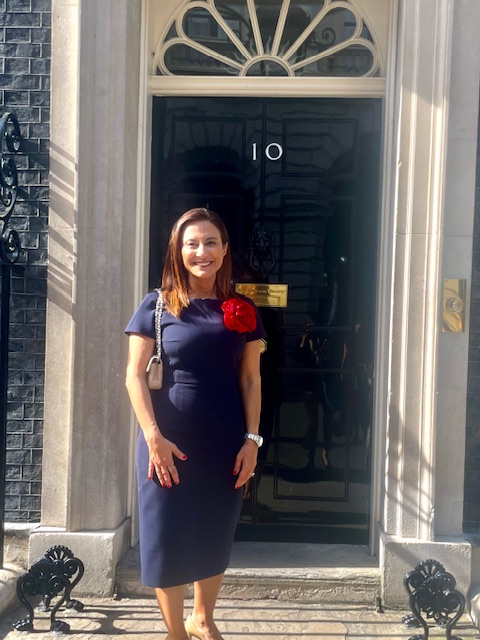
This also gave me opportunities to serve as an ambassador for diversity and inclusion. As a Turkish woman leader in the UK, I was often invited to speak at conferences and events (including at the Financial Times) about women in leadership. One of the most memorable moments was being invited to 10 Downing Street, joining other Asian women leaders to meet the Minister of State. We discussed how to act as role models for younger women in the UK and the importance of networking and mentoring.
These experiences touched me deeply. They are part of why I love this country, and why I am proud that my daughters also want to continue living here.
Reflection
Cultural differences matter.
Being an effective leader — building successful businesses and strong teams — starts with trust, communication, and openness. In the UK, I had many lessons to learn. But I also learned the importance of sharing my own perspective: why I asked questions the way I did, why sometimes my words might sound more direct, and how my background shaped me. By explaining myself, I created empathy, and each time I was open, my colleagues and clients understood me more. That’s how stronger, more trusting relationships were built.
Being curious, asking for help, and embracing cultural differences didn’t just help me adapt — it helped me connect. And it gave me friendships and experiences that I will always carry with me from my seven years in the UK.
Burçin Ressamoğlu
25 November 2025