
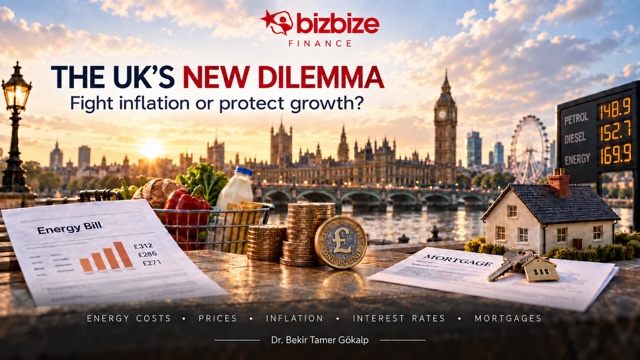
What do you do if the cause of inflation is an energy crisis that cannot be solved through interest rates?
There are periods in economic policymaking when the right course of action is more or less clear. If inflation rises, interest rates are increased; if the economy slows, interest rates are cut.
But sometimes, both problems arrive at the same time.
The UK is going through exactly such a period today.
On the one hand, inflation has begun to rise again; on the other, there is a need to protect growth and employment. Moreover, this time, one of the main causes of inflation lies not within the UK economy itself, but thousands of kilometres away: in energy prices.
UK consumer inflation rose to 3.1% year-on-year in August, up from 2.9% in July. More importantly, one of the main drivers of the increase was transport costs, particularly petrol and diesel prices.
The figures on the producer side are perhaps even more striking.
Input costs for British producers increased by 6.1% year-on-year in August. Factory-gate prices rose by 3.7%. Refined petroleum products were among the categories that stood out in terms of price increases.
In other words, the rise in oil prices has already begun to work its way through the production chain, even before its full impact has reached consumers’ pockets.
And this is where the real problem begins.
You Cannot Produce Oil by Raising Interest RatesThe Bank of England’s mandate is quite clear: to bring inflation back to its 2% target over the medium term.
Under normal circumstances, when inflation rises, the most powerful tool available to a central bank is the interest rate.
You raise interest rates. Credit becomes more expensive. Consumption and investment slow down. Demand falls, limiting companies’ ability to raise prices.
But things change if a significant part of today’s UK inflation is being driven not by excessive consumption, but by energy costs.
Because the Bank of England cannot produce more oil from the North Sea by raising interest rates. It cannot make more tankers pass through the Strait of Hormuz by increasing rates. Nor can a central bank end wars or increase global energy supply.
The Bank of England itself openly acknowledges this. The Bank says that monetary policy cannot influence global energy prices; its real task is to prevent an energy shock from spreading through the economy and turning into persistent inflation.
In my view, this is the most important sentence for understanding the UK economy today.
The UK Remembers Energy Driven InflationFor the UK, rising energy prices are not simply another economic development.
The country experienced this only very recently.
The energy crisis that began after the pandemic, followed by the surge in natural gas and electricity prices after the Russia–Ukraine war, played an important role in pushing UK inflation into double digits.
The Bank of England subsequently had to implement a very tight monetary policy. Interest rates rose as high as 5.25%.
As inflation declined, the pressure began to ease. Rate cuts started in August 2024, and the policy rate fell to 3.75% by December 2025.
Just as the British economy appeared to be emerging from the era of high interest rates, a new energy shock originating in the Middle East emerged.
In a sense, the UK now faces the prospect of walking back through the same door it exited only a few years ago.
The Bank of England’s Difficult ChoiceThe Bank of England will announce its interest rate decision today.
The current policy rate stands at 3.75%.
At the previous meeting, six of the nine members voted to keep rates unchanged, while three voted in favour of a 25-basis-point increase. The fact that only two members had supported a rate increase at the meeting before that also suggests that concern within the committee has been growing.
But the choice facing the Bank of England is far from easy.
If rates are raised, it may help prevent inflation expectations from becoming unanchored. Sterling could be supported, and the risk of the energy shock spreading into wages and other prices could be limited.
But there is a cost.
Higher interest rates mean more expensive mortgages, more expensive corporate borrowing, lower investment and weaker consumption. At the same time, the British economy also needs growth.
This is where the UK’s dilemma becomes clear:
How much can you slow the economy in order to control inflation?
And more importantly:
If the source of the problem is not demand but energy supply, how far can you use interest rates as your weapon?
The UK Is Not AloneThis is not just London’s problem. The US Federal Reserve moving back towards interest rate increases, UK inflation rising above 3% again, and higher energy costs are all parts of the same larger story.
Until just a few months ago, the world was discussing interest rate cuts by central banks.
Now we are talking about rate increases again.
Perhaps this has been the biggest surprise that 2026 has brought to financial markets.
But the UK’s situation also tells us something else.
Since the 1970s, the most difficult problem in central banking has not simply been high inflation.
The real challenge arises when inflation rises while the economy slows at the same time.
Because at that point, both paths available to the central bank come at a cost.
If you raise interest rates, you weaken growth.
If you begin cutting rates, you take the risk that inflation will become entrenched again.
The UK Could Become a LaboratoryFor this reason, I believe the UK economy will be particularly important to watch over the coming months.
The UK may become one of the first examples of the challenge that advanced economies could face in the period ahead.
If energy prices remain high, companies’ costs will rise. If companies pass those costs on to consumers, inflation will increase.
If workers demand higher wages to protect their purchasing power, a temporary energy-driven shock could turn into persistent inflation.
At precisely that point, the central bank would be forced to intervene again.
But as a result, growth could come under even greater pressure.
So the issue today is not simply whether UK interest rates will be 3.75% or 4%.
The real issue is much bigger.
For many years, the global economy built a growth model based on cheap energy and cheap money.
Now, however, we face the possibility of entering a period in which both energy and money are expensive.
If this period lasts for a long time, it will reshape not only central bank policies, but many other areas as well — from corporate investment decisions to government borrowing, from consumer spending to global capital flows.
So while all eyes may be on the Bank of England today, the question being asked in London is actually a question for the entire global economy:
How much growth can you sacrifice while fighting inflation?
And perhaps more importantly:
What do you do if the cause of inflation is an energy crisis that cannot be solved through interest rates?
Author
Published date
17.09.2026

Leave a Comment